Pregnancy Week by Week: A Complete Guide
A complete week-by-week pregnancy guide covering baby development, common symptoms, and key milestones from week 4 all the way to your due date.
Pregnancy is measured in weeks for a reason — a lot changes in seven days. One week your baby is the size of a poppy seed; a few weeks later, a heartbeat is visible on ultrasound. Knowing what's happening (and when) makes the next 40 weeks feel a lot less like a mystery.
This guide walks through pregnancy week by week, trimester by trimester — what's developing, what you might feel, and which milestones tend to show up when. Jump to whichever stage you're in, or read start to finish if you're just getting your bearings.

- How Pregnancy Weeks Are Counted
- Pregnancy at a Glance: Trimester by Trimester
- First Trimester Week by Week (Weeks 1–13)
- Second Trimester Week by Week (Weeks 14–27)
- Third Trimester Week by Week (Weeks 28–40)
- Prenatal Appointment Schedule by Trimester
- Twins or Multiples: How the Timeline Differs
- Common Symptoms by Trimester
- When to Call Your Doctor
- FAQ
How Pregnancy Weeks Are Counted
Pregnancy is dated from the first day of your last menstrual period (LMP) — not from conception. That means by the time you get a positive test, you're already considered about 4 weeks along, even though conception happened roughly two weeks earlier.
This is why you'll sometimes see two different numbers floating around: gestational age (counted from LMP, what your doctor uses) and fetal age (counted from conception, about 2 weeks behind). Unless a source specifies otherwise, week-by-week guides — including this one — use gestational age.
Not sure exactly how far along you are or when your due date lands? Our free due date calculator works it out from either your last period or a known conception date, and breaks down which trimester and week you're currently in.
Pregnancy at a Glance: Trimester by Trimester
| Trimester | Weeks | What's Happening |
|---|---|---|
| First | 1–13 | Major organs form, heartbeat becomes detectable, morning sickness typically peaks |
| Second | 14–27 | Anatomy scan, first felt movements, energy often returns |
| Third | 28–40 | Rapid weight gain, lungs mature, baby positions for birth |
First Trimester Week by Week (Weeks 1–13)
The first trimester is the busiest stretch of development in the entire pregnancy — most major organs and body systems begin forming in these 13 weeks.
- Week 4 — The embryo implants in the uterine lining. hCG levels rise enough to trigger a positive pregnancy test.
- Week 5 — The neural tube, which becomes the brain and spinal cord, begins to close.
- Week 6 — A heartbeat can often be detected by transvaginal ultrasound. The embryo is roughly the size of a lentil.
- Week 7 — Arm and leg buds appear. The embryo's brain is producing about 100 new cells per minute.
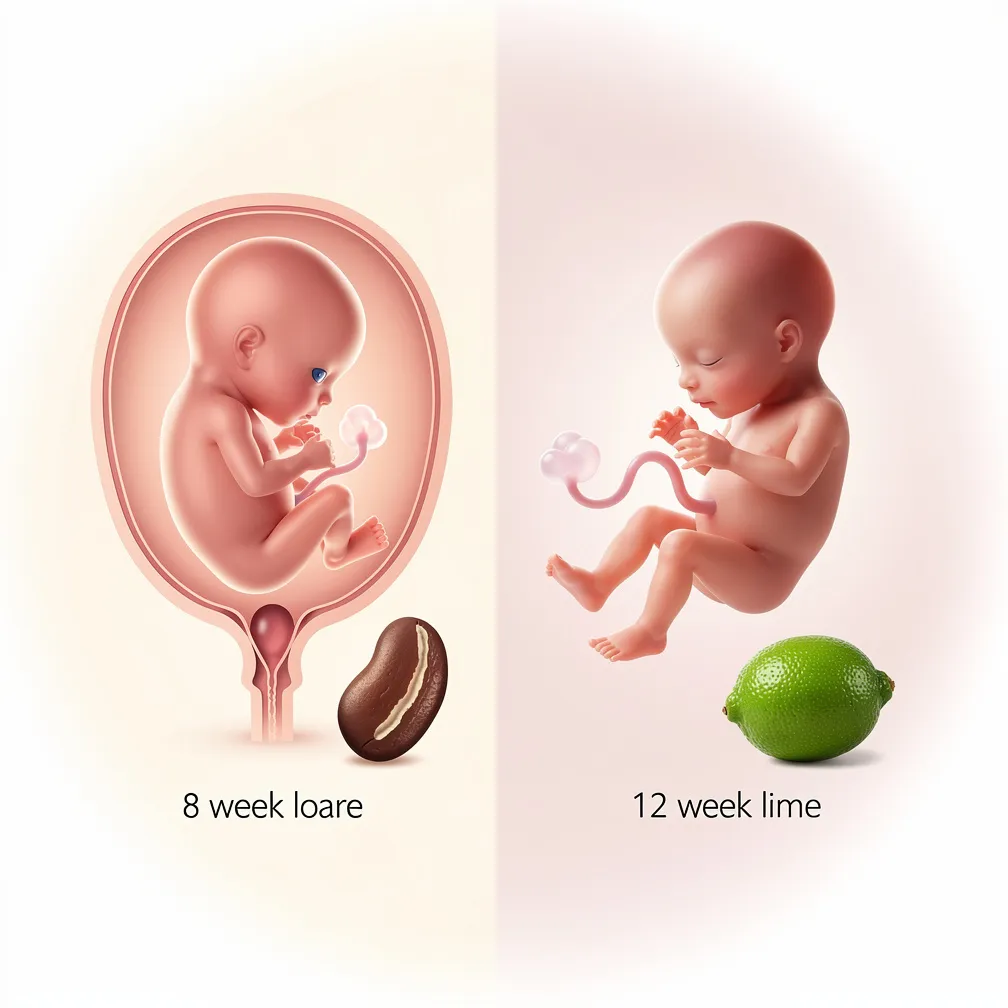
- Week 8 — Now officially called a fetus. About the size of a kidney bean, with webbed fingers and toes starting to separate.
- Week 9 — Basic facial features — eyelids, tiny nose, upper lip — are taking shape.
- Week 10 — Fingernails and toenails begin forming. Vital organs are in place and starting to function.
- Week 11 — The fetus can hiccup and make small, jerky movements — though you won't feel them yet.
- Week 12 — Reflexes are developing; toes may curl and fingers may open and close.
- Week 13 — End of the first trimester. Miscarriage risk drops significantly from this point, and many people find nausea starts to ease.
Naturally curious about how that due date at the end of this trimester was calculated? The due date calculator guide breaks down the exact formula doctors use.
Second Trimester Week by Week (Weeks 14–27)
Often called the "honeymoon trimester" — morning sickness typically fades, energy tends to return, and for many people this is when pregnancy starts to feel real in a good way.
- Week 14 — Facial muscles start working, so the fetus may squint, frown, or grimace.
- Week 16 — The skeleton is hardening from soft cartilage into bone. Some people start feeling the first faint flutters ("quickening") around now or a bit later.
- Week 18 — Ears are in their final position, and hearing is developing — the fetus may start responding to sound.
- Week 20 — The halfway point. This is typically when the anatomy scan happens, checking major organs and often revealing the baby's sex.
- Week 22 — Eyebrows and eyelids are fully formed. The fetus is developing a sleep-wake pattern.
- Week 24 — Considered a viability milestone — with intensive medical care, babies born at this point have a chance of survival, though lung development is still the main hurdle.
- Week 26–28 — Many providers screen for gestational diabetes in this window using the glucose challenge test. If that test comes back on your radar, our guide to gestational diabetes covers what the numbers mean and what happens next.
- Week 27 — End of the second trimester. Eyes can open, and brain activity is measurable on tests.
Third Trimester Week by Week (Weeks 28–40)
The home stretch. Most of the baby's weight gain happens now, and the final weeks are largely about lung maturity and getting into position for birth.
- Week 28 — The fetus can hear sounds from outside the womb and may react to light. REM sleep begins.
- Week 30 — Bones are fully formed but still soft and flexible. Brain development is accelerating quickly.
- Week 32 — "Practice breathing" starts — inhaling and exhaling small amounts of amniotic fluid to strengthen the lungs. Many babies have turned head-down by now.
- Week 34 — Central nervous system and lungs continue maturing. Fingernails reach the fingertips.
- Week 36 — Considered "early term." Most major development is complete, with roughly 30g of fat gained per day.
- Week 37–38 — "Full term" begins. Lungs are typically mature enough for the baby to breathe independently.
- Week 39–40 — Your due date sits at week 40, but going into labor anywhere from week 37 to 42 is considered normal — only an estimated 5% of babies actually arrive on their exact due date.

Prenatal Appointment Schedule by Trimester
Alongside the week-by-week development, most providers follow a fairly predictable visit schedule. Exact timing varies by provider and by risk factors, but this is the general pattern:
| Weeks | Typical Frequency | What Usually Happens |
|---|---|---|
| 4–28 | Every 4 weeks | Weight, blood pressure, urine checks; first-trimester bloodwork; dating ultrasound |
| 20 | One-time (within this window) | Anatomy scan — detailed check of organs, growth, and often sex |
| 24–28 | One-time (within this window) | Gestational diabetes screening (glucose challenge test) |
| 28–36 | Every 2 weeks | Growth checks, group B strep discussion, birth plan conversations |
| 36–40 | Weekly | Cervical checks, baby's position, monitoring for signs of labor |
If you're considered higher-risk — carrying multiples, managing a pre-existing condition, or flagged during a screening — your provider may schedule visits more frequently than this general pattern.
Twins or Multiples: How the Timeline Differs
Most week-by-week guides are written with a single baby in mind, but the timeline shifts in a few notable ways with twins or higher-order multiples:
- Earlier ultrasounds — because dating and confirming the number of babies (and whether they share a placenta) matters more, ultrasounds often start earlier and happen more frequently.
- Full term arrives sooner — full term for twins is generally considered 37 weeks rather than 39, since twin pregnancies carrying to 40 weeks are the exception rather than the rule.
- Symptoms can be more pronounced — nausea, fatigue, and later shortness of breath or swelling tend to show up earlier and more intensely, simply because there's more going on.
- More frequent monitoring in the third trimester — growth scans and non-stress tests are typically added earlier than in a singleton pregnancy to keep an eye on both babies' growth curves.
If you're expecting multiples, treat the week-by-week milestones above as a general reference point rather than an exact match — your care team will tailor the schedule to your specific situation.
Common Symptoms by Trimester
Every pregnancy is different, and symptoms vary widely from person to person — but here's a general pattern many people report:
- First trimester — nausea, fatigue, tender breasts, frequent urination, heightened sense of smell, food aversions.
- Second trimester — round ligament pain, mild back discomfort, nasal congestion, increased appetite, a "glow" some attribute to hormonal changes and increased blood volume.
- Third trimester — Braxton Hicks contractions, swelling in the feet and ankles, shortness of breath as the uterus presses on the diaphragm, trouble sleeping, more frequent trips to the bathroom as the baby drops lower.
These are common patterns, not guarantees — some people sail through with almost no symptoms, while others experience them more intensely. If anything feels severe or out of the ordinary, it's always worth a call to your provider.
When to Call Your Doctor
Most pregnancy symptoms are uncomfortable but not dangerous. That said, the American College of Obstetricians and Gynecologists (ACOG) recommends contacting your provider promptly for symptoms like:
- Vaginal bleeding or fluid leakage
- Severe or persistent headache, especially with vision changes
- Sudden swelling in the face or hands
- A noticeable decrease in fetal movement
- Contractions before 37 weeks
- Fever, chills, or severe abdominal pain
This isn't a complete list, and it isn't a substitute for guidance from your own provider — when in doubt, it's always reasonable to call. (Source: ACOG)
FAQ
How many weeks is a full-term pregnancy? A pregnancy is considered "full term" between 39 and 40 weeks, 6 days. "Early term" covers 37–38 weeks, and "late term" is 41 weeks through 41 weeks, 6 days.
Why do doctors count pregnancy from my last period instead of conception? Most people know when their last period started but not the exact day they conceived. Counting from the last menstrual period gives a consistent, practical starting point — even though it means you're "2 weeks pregnant" before conception technically happens.
When will I feel the baby move? First-time parents often start noticing flutters, sometimes called quickening, between weeks 18 and 22. If you've been pregnant before, you may recognize the sensation a little earlier, since you know what to look for.
What's the difference between gestational age and fetal age? Gestational age is counted from your last menstrual period and is what your due date and prenatal appointments are based on. Fetal age is counted from conception and runs about two weeks behind gestational age. Week-by-week guides, including this one, use gestational age unless stated otherwise.
Do all pregnancies follow this exact week-by-week timeline? No — this is a general guide based on typical development patterns. Every pregnancy progresses a little differently, and your provider's guidance always takes priority over general timelines like this one.
Can my due date change as the pregnancy goes on? Yes. An early ultrasound (typically before 14 weeks) is often more accurate than a due date based on your last period alone, and providers will sometimes adjust the due date if there's a meaningful difference between the two. A shift of a few days is common and isn't a cause for concern.
Related guides
- How Is Your Due Date Actually Calculated? — the exact formula behind your due date, plus a free calculator
- Gestational Diabetes: What You Need to Know — what the second-trimester screening involves and what a diagnosis means
Every pregnancy moves at its own pace — think of these weeks as a map, not a countdown.
Ready to throw the best reveal?
Create your free Poppit event — invitations, live betting pool, and registry in one link.
Create your event ✨