4 Weeks Pregnant: Symptoms, Baby Size & What to Expect
At 4 weeks pregnant, your baby is poppy-seed sized and the neural tube starts closing. Symptoms, baby development, and a full week 4 checklist.
At 4 weeks pregnant, your baby — now officially an embryo — is about the size of a poppy seed, and this is usually the week a home pregnancy test turns positive for the first time. Implantation has just finished, hCG is climbing fast, and the very first structure that will become your baby's brain and spinal cord, the neural tube, starts forming.
If you're not sure your dates line up, gestational age counts from the first day of your last period (LMP), not from conception — so "4 weeks pregnant" usually means about 2 weeks since ovulation and roughly 1–2 weeks since implantation. For the full timeline, see our pregnancy week-by-week guide. If you're coming from last week's post, catch up on 3 weeks pregnant first.
Key takeaways
- Baby is about the size of a poppy seed (roughly 0.36–1 mm) and is now called an embryo, not a blastocyst.
- The neural tube — the earliest form of the brain and spinal cord — starts closing this week, which is why folic acid matters right now more than almost any other week.
- Most home pregnancy tests can detect a positive result by the end of this week, since hCG typically reaches the ~20–25 mIU/mL detection threshold around now.
What "4 Weeks Pregnant" Actually Means
Using standard gestational dating, week 4 starts about 2 weeks after ovulation and roughly 6–10 days after fertilization — right when implantation is wrapping up. In fetal-age terms (counting from conception instead of your last period), this is closer to "2 weeks post-conception," which is one reason early pregnancy dating conversations get confusing fast.
This is also the week the story usually starts for most people, since it's the first time a home test can reliably confirm what's already been happening quietly in the body since week 3.
Baby Size at 4 Weeks
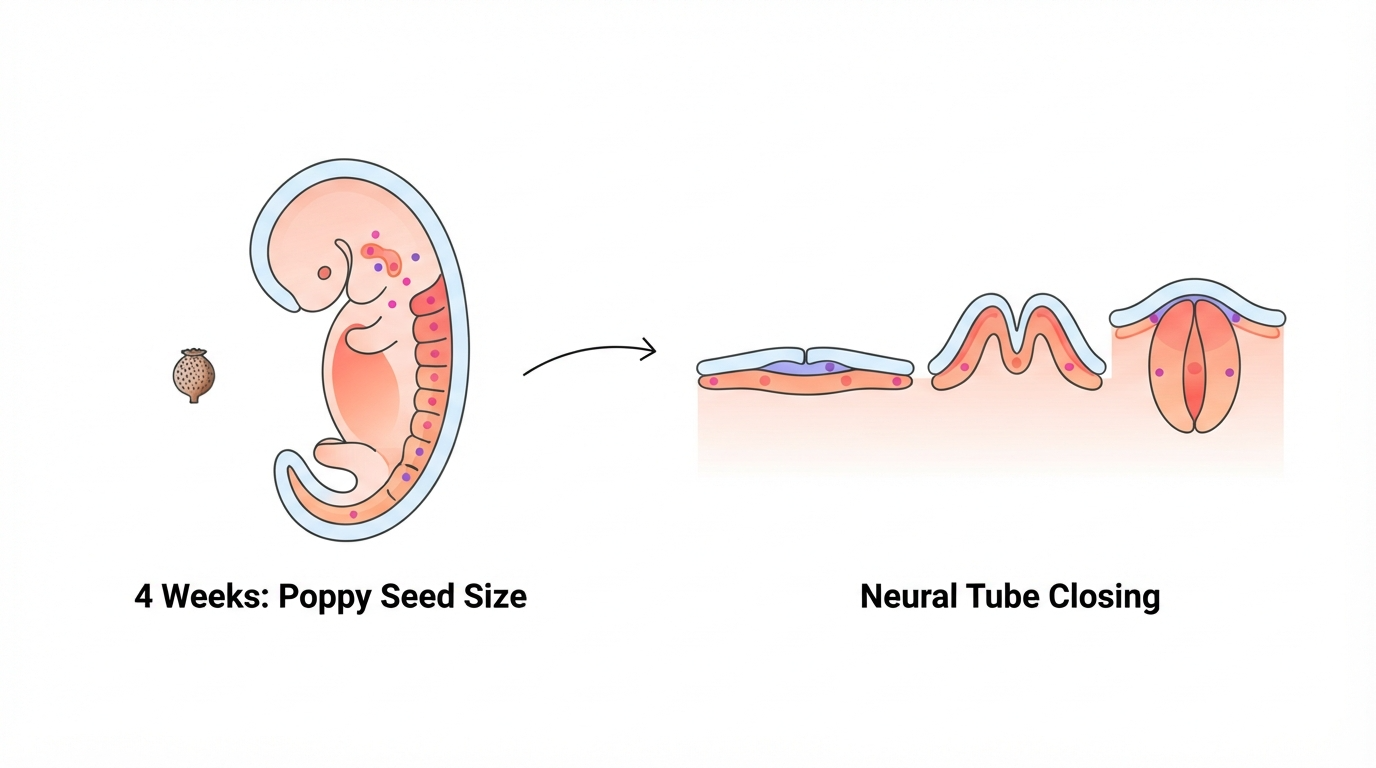
At 4 weeks, your baby is an embryo about the size of a poppy seed — roughly 0.36 to 1 millimeter long. It's still far too small to see on a standard ultrasound, and there's no fetal heartbeat yet; that typically becomes detectable around week 6. What's happening instead is structural: the embryo has organized into three distinct layers (the ectoderm, mesoderm, and endoderm) that will eventually form every organ system, starting with the nervous system.
The Neural Tube: What's Actually Forming This Week
This is the headline event of week 4. Early in the week, the embryo is a flat, three-layered disc. Over the next several days, the edges of that disc fold upward and inward, meeting in the middle to form a hollow tube running the length of the embryo — the neural tube. This structure will become the brain and spinal cord.
Neural tube closure begins around day 22 after fertilization and is typically complete by around day 28 — putting the whole process squarely inside week 4 for most pregnancies. (Source: CDC) The tube closes from the middle outward in both directions, like a zipper opening from the center — the head end and the tail end are the last parts to seal.
Why folic acid timing matters so much right now. Neural tube defects, like spina bifida, happen when this closure process doesn't complete properly. Because closure is often finishing before many people even get a positive test, providers recommend starting folic acid before conception rather than waiting for confirmation — by the time you see two lines, the window is already mostly closed. (Source: ACOG)
What You Might Notice at 4 Weeks Pregnant
hCG is rising fast this week — often doubling every 48–72 hours — and that's what drives most of the earliest pregnancy symptoms. Not everyone feels anything yet, but here's what commonly shows up:
A positive pregnancy test. For most people, hCG crosses the ~20–25 mIU/mL threshold most home tests need sometime during week 4, often right around the day of a missed period. A faint line still counts as positive — test sensitivity, not pregnancy strength, usually explains a faint line.
Breast tenderness or swelling. Rising estrogen and progesterone increase blood flow to breast tissue, which can make breasts feel fuller, heavier, or more sensitive to touch than a typical premenstrual week.
Fatigue. Progesterone has a sedating effect, and by week 4 levels are high enough that a lot of people notice real, sometimes overwhelming tiredness — even before other symptoms show up.
Mild cramping. Some people feel light, period-like cramps as the uterus adjusts and blood flow to the area increases. It's usually milder and briefer than typical period cramps.
Nausea (occasionally starting early). Full-blown morning sickness usually peaks around weeks 6–9, but some people notice mild queasiness as early as week 4, especially with sensitivity to smells.
Frequent urination. As blood volume starts to increase and hCG affects blood flow to the pelvis, some people notice needing to urinate more often, even this early.
It's just as normal to feel nothing at all yet — symptom timing and intensity vary widely, and plenty of confirmed pregnancies feel symptom-free at 4 weeks.
What's Happening in Your Body
- hCG keeps climbing. Levels roughly double every 2–3 days during this stretch, which is what makes a home test reliable by the end of the week.
- The neural tube closes. As covered above, this is the defining developmental event of week 4.
- The placenta starts forming. Specialized cells from the former blastocyst (the trophoblast) continue developing into the early placenta, which will eventually take over hormone production from the ovaries.
- The yolk sac and amniotic sac develop. These temporary structures support the embryo with nutrients and a protective fluid-filled environment before the placenta is fully functional.
- Progesterone stays elevated, maintained by the corpus luteum on the ovary, keeping the uterine lining stable and supporting the pregnancy until the placenta takes over that job.
Tips for Week 4
Take a pregnancy test if your period is late. Given hCG timing, week 4 is when home tests become genuinely reliable — testing first thing in the morning, when urine is most concentrated, gives the clearest result.
Start (or keep taking) a prenatal vitamin with folic acid. Given that neural tube closure is wrapping up right now, this is one of the highest-leverage things you can do this week if you haven't already started.
Book a prenatal appointment. Most providers schedule the first visit around 8 weeks, but it's worth calling now once you have a positive test so you're on the schedule.
Cut out alcohol and tobacco. Both interfere with neural tube and early organ development, so this week — not "once it's confirmed further along" — is the time to stop.
Watch what you eat, loosely. Avoid raw or undercooked meat, unpasteurized dairy, and high-mercury fish; you don't need to overhaul your whole diet overnight, but these are worth cutting now.
Go easy on yourself around fatigue. If exhaustion hits hard, it's not a sign anything's wrong — it's a normal response to a sharp rise in progesterone.
Tips for Partners
- Take the "late period → test → wait" stretch seriously. This week can be an emotional loop of hope and uncertainty; checking in without pressuring for an answer helps.
- Offer to pick up folic acid or a prenatal vitamin if one isn't already in the house — a small, concrete action that matters this exact week.
- Expect fatigue and mild moodiness, and don't read too much into it — it's hormonal, not personal.
- Hold off on sharing the news until your partner is ready; many people wait until after a first ultrasound given early-pregnancy uncertainty.
FAQ
How big is my baby at 4 weeks pregnant? About the size of a poppy seed — roughly 0.36 to 1 millimeter. It's officially called an embryo at this stage, no longer a blastocyst.
Can you see anything on an ultrasound at 4 weeks? Usually not much. At most, a very early gestational sac might be visible; the embryo itself and a heartbeat aren't typically detectable until around weeks 5–6.
What is the neural tube and why does it matter at 4 weeks? The neural tube is the earliest structure that becomes the brain and spinal cord. It closes during week 4, which is why folic acid intake matters most in the weeks leading up to and including this one. (Source: CDC)
Will a pregnancy test be positive at 4 weeks? For most people, yes — hCG typically reaches a detectable level (around 20–25 mIU/mL) sometime during week 4, often right around a missed period.
What symptoms are normal at 4 weeks pregnant? Breast tenderness, fatigue, mild cramping, and occasionally early nausea or frequent urination are all common. Feeling nothing yet is also completely normal.
Is cramping at 4 weeks a bad sign? Mild, brief cramping is usually normal as the uterus adjusts to increased blood flow. Persistent, severe, or one-sided pain — or heavy bleeding — is worth calling your provider about.
When should I schedule my first prenatal appointment? Most providers schedule the first visit around 8 weeks, but it's fine to call as soon as you get a positive test to get on the calendar.
Pregnancy Checklist at Week 4
- Take a pregnancy test if your period is late, ideally first thing in the morning
- Start or continue a prenatal vitamin with folic acid
- Call to schedule your first prenatal appointment
- Cut out alcohol and tobacco
- Avoid raw/undercooked meat, unpasteurized dairy, and high-mercury fish
- Rest when fatigue hits — it's a normal response to rising progesterone
Related guides
- 3 Weeks Pregnant: Symptoms, Baby Size & What to Expect — what happens the week before implantation finishes
- Pregnancy Week by Week: A Complete Guide — see what happens in every week and trimester, from implantation to full term
- How Is Your Due Date Actually Calculated? — the exact formula behind your due date, plus a free calculator
Week 4 is where the quiet cellular work of the last few weeks turns into something you can actually confirm — and where the neural tube, one of the most important structures in the whole pregnancy, finishes closing before most people even know for sure they're expecting.
Read related post
Ready to throw the best reveal?
Create your free Poppit event — invitations, live betting pool, and registry in one link.
Create your event ✨