1 Week Pregnant: Symptoms, Baby Size & What to Expect
At 1 week pregnant, you're not actually pregnant yet — here's what's really happening in your body, why doctors count it this way, tips for conceiving, and a full week 1 checklist.
If you just searched "1 week pregnant," here's the short answer: there's no baby yet. Doctors date pregnancy from the first day of your last period, which means week 1 is actually your period — conception hasn't happened yet.
One quick note before we go further: if you're here because you think you conceived about a week ago, you're probably already 3–4 weeks pregnant, not 1 — gestational dating counts from your last period, not from conception. Feel free to jump ahead to our pregnancy week-by-week guide and find your actual week. If you're tracking your cycle and want to know what week 1 really means, read on.
Key takeaways
- You're not actually pregnant yet at week 1 — this is your period, and it marks the start of a new cycle, not a pregnancy.
- There's no baby and no embryo to measure — ovulation and conception are both still roughly two weeks away.
- If you're trying to conceive, this is the week to start a prenatal vitamin with folic acid and begin tracking your cycle for signs of ovulation.
What "1 Week Pregnant" Actually Means
Pregnancy is measured using gestational age — counted from the first day of your last menstrual period (LMP), not from conception. Since ovulation and conception typically happen around day 14 of a cycle, "1 week pregnant" really refers to the week your period starts, roughly two weeks before you actually conceive.
It's a strange system, but there's a practical reason for it: most people can pinpoint the first day of their last period far more reliably than the exact day they conceived. For the full breakdown of how this dating system works across all 40 weeks, see our pregnancy week-by-week guide.
Baby Size at 1 Week
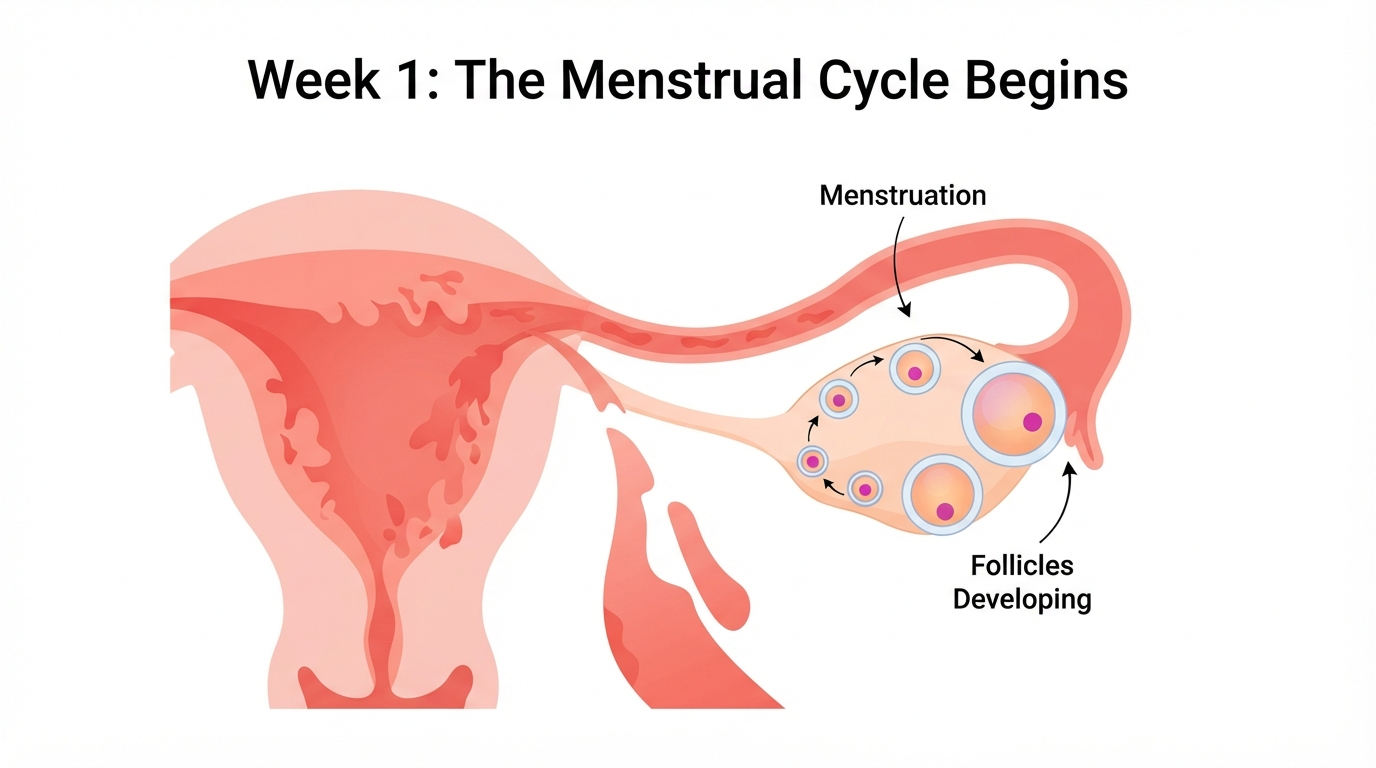
There's no embryo to measure yet — at this stage, an egg hasn't even been released. Instead, your ovaries are recruiting a group of follicles, each containing an immature egg, and preparing to select one to mature and release around day 14. Fetal development milestones (and the size comparisons that go with them, like "poppy seed" or "lentil") don't really start until around week 4, once implantation has occurred.
Symptoms at 1 Week Pregnant
Since week 1 overlaps with your period, the symptoms you're feeling now are period symptoms, not pregnancy symptoms. Here's what each one actually involves:
Menstrual bleeding. This is the main event of week 1 — the uterine lining from your last cycle shedding, typically lasting 3–7 days.
Cramping. Prostaglandins (hormone-like compounds) trigger uterine contractions to help shed the lining, which is felt as cramping in the lower abdomen or back.
Fatigue. Blood loss combined with shifting hormone levels can leave you feeling more tired than usual during your period.
Bloating. Hormonal shifts around the start of your cycle commonly cause water retention and digestive changes, leading to that "bloated" feeling.
Mood changes. The sharp drop in estrogen and progesterone that triggers your period can also affect mood and energy for the first few days.
None of these are early pregnancy signs — they're your body shedding the uterine lining from the previous cycle so it can build a fresh one, in case this cycle results in a pregnancy.
What's Happening in Your Body
Behind the scenes, your body is resetting for a new cycle:
- Hormone levels drop. Estrogen and progesterone fall at the end of the previous cycle, which triggers your period.
- FSH rises. Follicle-stimulating hormone (FSH) increases, prompting several ovarian follicles to start developing.
- The uterine lining sheds. This is your period — the lining built up during the last cycle isn't needed and is shed.
- A new lining starts building. Even as you're bleeding, your uterus is already preparing a new lining for a potential embryo.
By the end of this week, one follicle typically becomes dominant and continues maturing toward ovulation, which usually occurs around day 14 of an average 28-day cycle. (Source: ACOG)
If You're Trying to Conceive
If you're actively trying, week 1 is a good time to set a few things in motion rather than wait for symptoms that won't show up for weeks:
- Start (or continue) a prenatal vitamin with folic acid. Neural tube development begins very early — often before a positive test — so starting folic acid before conception matters.
- Track your cycle. Note the first day of bleeding (that's day 1) and, if possible, ovulation signs like cervical mucus changes or a basal body temperature shift, to estimate your fertile window.
- Book a preconception visit if you haven't already. Your provider can check your health history, medications, and immunizations before you start trying. (Source: ACOG)
- Cut back on alcohol and tobacco now, since you won't know the exact moment conception happens later in the cycle.
- Know the odds per cycle. For couples actively trying, the average chance of conceiving in any single cycle is roughly 20–30% — which is why it commonly takes several cycles, even when everything is working normally. (Source: ACOG)
Tips for Partners
- Share the healthy habits. Cutting back on alcohol and eating well alongside your partner makes the whole process easier to stick with.
- Help with cycle tracking. Knowing roughly where things stand in the cycle helps both of you plan for the fertile window in the weeks ahead.
- Go easy on this week specifically. Period week can come with cramping and fatigue — this is more a week for support than for "trying."
When You'll Actually Know You're Pregnant
Even if conception happens this cycle, you won't get a reliable positive test for a few more weeks. Implantation doesn't occur until roughly a week after ovulation (around what's counted as week 4), and it takes a few more days after that for hCG levels to build up enough to detect. Most home tests can't reliably confirm a pregnancy until close to the time of your next missed period — right around week 4 to 5.
FAQ
Is there actually a baby at 1 week pregnant? No. At 1 week, you're in the process of menstruating, and ovulation hasn't happened yet. Conception typically occurs around week 2–3 using standard gestational dating.
Why do doctors count pregnancy from my period if I'm not pregnant yet? Because your last menstrual period is a reliable, known date, while your exact conception date usually isn't. Counting from LMP gives providers a consistent starting point for every pregnancy, even though it means the first two weeks technically happen before conception.
What symptoms should I expect at 1 week pregnant? Just your normal period symptoms — bleeding, cramping, fatigue, and bloating. True early pregnancy symptoms, like nausea or breast tenderness, typically don't start until several weeks later, if at all.
Can a pregnancy test be positive at 1 week? No. There's no embryo yet at this point, so there's nothing to produce the hCG hormone a test detects. A reliable result is still roughly a month away.
When can I take a pregnancy test? Wait until at least the day of your expected next period for a reliable result — testing earlier increases the chance of a false negative, since hCG needs time to build up after implantation.
What can I do at 1 week to improve my chances of conceiving? Start a prenatal vitamin with folic acid if you haven't already, track your cycle to identify your fertile window, and maintain the general healthy habits (avoiding alcohol, managing stress, staying active) your provider would normally recommend.
Pregnancy Checklist at Week 1
- Note the first day of bleeding — that's day 1 of your cycle
- Start (or continue) a prenatal vitamin with folic acid
- Book a preconception visit with your OB-GYN if you haven't already
- Begin tracking cycle length and any early ovulation signs
- Cut back on alcohol and tobacco
- Hold off on testing — it's far too early for a reliable result
Related guides
- 2 Week Pregnant: Symptoms, Baby Size & What to Expect — what's happening the week after this one
- Pregnancy Week by Week: A Complete Guide — see what happens in every week and trimester, from implantation to full term
- How Is Your Due Date Actually Calculated? — the exact formula behind your due date, plus a free calculator
Week 1 is really just the starting line — the real story begins once ovulation and conception happen in the weeks ahead.
Ready to throw the best reveal?
Create your free Poppit event — invitations, live betting pool, and registry in one link.
Create your event ✨