2 Week Pregnant: Symptoms, Baby Size & What to Expect
At 2 weeks pregnant, ovulation is happening and conception may occur this week. Symptoms, what's happening in your body, tips for conceiving, and a full week 2 checklist.
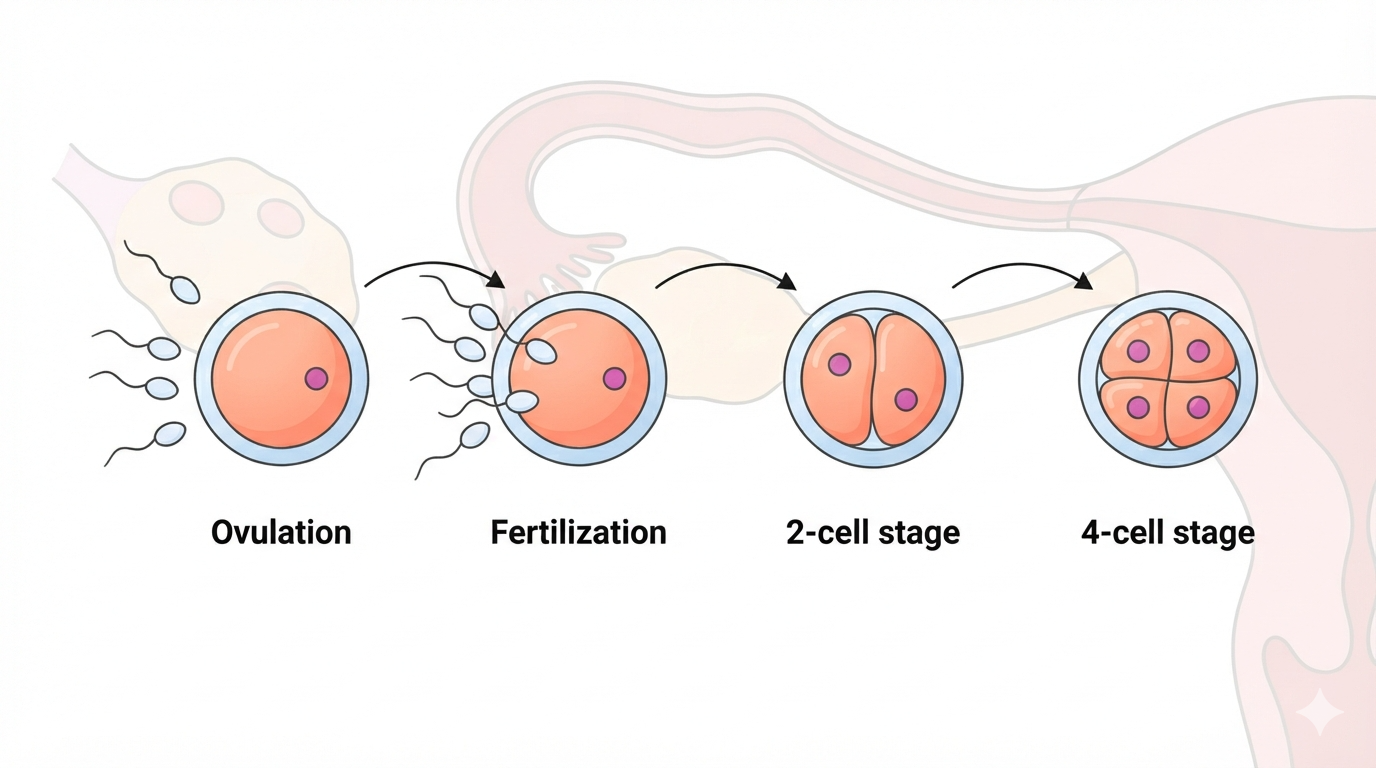
Using standard gestational dating, "2 weeks pregnant" is the week ovulation happens — and if sperm meets egg this week, it's also the week conception actually occurs. Still no embryo to measure yet, but this is the most eventful week so far.
One quick note before we go further: if you're here because you got a positive pregnancy test recently and think you're "2 weeks in," you're almost certainly further along than that. A positive test means enough pregnancy hormone has built up for detection, which typically doesn't happen until around week 4. Feel free to jump ahead to our pregnancy week-by-week guide and find your actual week. If you're instead tracking your cycle and wondering what week 2 really means, read on.
Key takeaways
- You're not actually pregnant yet at this point — you're in the fertile window of your menstrual cycle, and ovulation is likely happening this week.
- Watch for the subtle signs of ovulation, or use an ovulation predictor kit to pinpoint your most fertile days.
- If you're trying to conceive, this is the week to start (or keep up) a prenatal vitamin, cut back on alcohol, and make sure sex is timed across your fertile window, not just on one day.
What "2 Weeks Pregnant" Actually Means
Doctors count pregnancy from the first day of your last menstrual period (LMP), not from conception. By that math, week 2 lines up with roughly the middle of your cycle — the week your body releases an egg. For most people with an average 28-day cycle, ovulation happens around day 14, which falls right in this window.
If you haven't already, week 2 is a reasonable time to book a preconception visit with your OB-GYN if you're planning to try. They'll typically check your blood pressure, review your medical history and medications, and confirm you're set up for a healthy pregnancy before you conceive. (Source: ACOG)
Baby Size at 2 Weeks
There's still no embryo for most of this week. What exists is a mature egg — released from the dominant follicle during ovulation, and roughly a tenth of a millimeter across, far too small to see without a microscope. If fertilization occurs, that egg becomes a rapidly dividing cluster of cells over the following days. That cluster won't implant in the uterine lining until roughly a week later, which is when it's typically first counted as an embryo. Size comparisons like "poppy seed" don't start until around week 4.
Symptoms of Ovulation at 2 Weeks Pregnant
Any symptoms you notice this week are ovulation symptoms, not pregnancy symptoms — pregnancy hormones haven't risen yet. Here's what each one actually means:
Egg-white cervical mucus. As ovulation nears, cervical mucus becomes thinner, clearer, and stretchier — often compared to raw egg whites. This texture change makes it easier for sperm to travel toward the egg, and it's one of the more reliable at-home fertility signs.
One-sided pelvic twinge (mittelschmerz). As your ovary releases an egg, you may feel a brief ache or twinge on one side of your lower abdomen, lasting anywhere from a few minutes to a day.
Breast tenderness. The hormone surge around ovulation can make breasts feel slightly sore or full, similar to premenstrual tenderness.
A temporary rise in libido. An uptick in sex drive around ovulation is common and is thought to be one of the body's natural cues toward the fertile window.
Light spotting. A small amount of spotting can occur around ovulation for some people. It's usually harmless, but mention anything heavier or unusual to your provider.
A basal body temperature shift. Body temperature typically dips slightly, then rises by half a degree or so after ovulation — a pattern people who chart their cycles often track closely.
Cervical position changes. For those who check cervical position as part of fertility tracking, the cervix tends to sit higher, feel softer, and open slightly around ovulation.
None of these confirm pregnancy on their own — they're your body's normal ovulation signals, and they show up whether or not conception happens this cycle.
If Conception Happens This Week: Signs to Watch For Later
It's worth being clear about timing: even in the best-case scenario, none of the symptoms below show up this week. They're the early pregnancy signs that can appear starting a couple of weeks from now, once hormone levels have had time to rise — but people searching "2 weeks pregnant symptoms" are often really asking what to watch for down the line, so here's the preview:
- Implantation spotting — a small amount of spotting roughly 10–14 days after conception, as the fertilized egg attaches to the uterine lining
- Frequent urination — rising pregnancy hormones increase trips to the bathroom
- Sore breasts or darker areolas — early hormonal changes as the body starts preparing for breastfeeding
- Fatigue — a very common early sign, often felt before a missed period
- Morning sickness — typically starts around week 4–9, not before
- Bloating — digestion tends to slow slightly as the body prioritizes nutrient delivery
If you notice any of these in the coming weeks, that's the point to consider taking a home pregnancy test.
What's Happening in Your Body
This week is driven by a hormonal cascade:
- LH surge. A sharp rise in luteinizing hormone (LH) triggers ovulation, typically 24–36 hours after the surge begins. This is what ovulation predictor kits detect. (Source: ACOG)
- Ovulation. The dominant follicle releases a mature egg into the fallopian tube.
- The fertile window. The egg survives only about 12–24 hours after release, but sperm can survive up to 5 days in cervical mucus — which is why the fertile window spans roughly 6 days: the 5 days before ovulation plus the day of. (Source: ACOG)
- Fertilization, if it happens. Sperm meets egg in the fallopian tube. The fertilized egg then begins a slow, multi-day journey toward the uterus, dividing into a small ball of cells along the way.
By the end of this week, if fertilization occurred, you have a rapidly dividing cluster of cells en route to the uterus — but nothing implanted, and nothing hormonally detectable, yet.
Tips If You're Trying to Conceive
Week 2 is the highest-stakes week of the cycle if you're actively trying:
- Time intercourse across the whole fertile window — every 1–2 days in the days leading up to and including ovulation — rather than trying to hit one "perfect" day. Since sperm can survive several days waiting for the egg, consistent timing across the window matters more than precision on a single date.
- Watch for ovulation signs. Cervical mucus changes and an ovulation predictor kit (which detects the LH surge) are the two most reliable at-home signals.
- Support fertility through diet. A generally healthy diet — folate-rich foods like leafy greens, beans, and citrus, alongside enough protein and healthy fats — supports conception, though no single food guarantees results.
- Cut back on alcohol and tobacco now, not after a positive test — since you may not know the exact moment conception happens, and there's no known safe amount of alcohol during pregnancy.
- Manage stress where you can. High stress is linked to a somewhat lower likelihood of conceiving in a given cycle, so building in rest and downtime isn't just a nice-to-have.
- Keep taking a prenatal vitamin with folic acid. If fertilization happens this week, neural tube development begins almost immediately afterward.
- Don't test yet. A pregnancy test this week will be negative regardless — there simply isn't enough hCG to detect, even if conception happened.
Tips for Partners
Trying to conceive is a two-person effort, and there's a real role for a partner to play this week:
- Share the healthy habits, not just the timing. Cutting back on alcohol, eating well, and getting decent sleep alongside your partner makes it easier for both of you to stick with it.
- Get moving together. A shared walk, hike, or workout is a low-pressure way to spend time together during a stretch that can otherwise feel very schedule-driven.
- Keep the pressure off intimacy. Timed, planned sex can start to feel like a task — checking in about how it's feeling for both of you goes a long way.
- Go to the preconception visit together, if possible. It's a good opportunity to ask questions as a couple, not just for the person who'll be carrying the pregnancy.
When You'll Actually Know You're Pregnant
Even in the best-case timeline — fertilization occurring right on schedule this week — implantation doesn't happen until about a week later (around week 4), and hCG needs several more days to build up after that. Realistically, the earliest a home pregnancy test can give a reliable result is right around the time of your next missed period, which is still roughly two weeks away.
FAQ
Is there a baby at 2 weeks pregnant? Not yet, for most of the week. If conception happens on schedule, you'll have a fertilized egg dividing on its way to the uterus by the end of the week — but it's not yet implanted or detectable.
Is 2 weeks pregnant when conception actually happens? Often, yes. Using standard gestational dating, ovulation and possible fertilization typically occur during week 2, even though the "2 weeks pregnant" label starts two weeks before conception on the calendar.
Can a pregnancy test be positive at 2 weeks? No. Even if fertilization happens exactly on schedule, there isn't enough hCG in your system yet for a home test to detect. A reliable result is still roughly two weeks away, around the time of your next missed period.
Can you be 2 weeks pregnant and still have a period? Not in the sense of an active pregnancy — but light ovulation spotting can sometimes be mistaken for a light period. A true period during an established pregnancy isn't typical; if you're unsure what you're seeing, it's worth mentioning to your provider.
What foods support fertility? No single food makes you more fertile, but a generally balanced diet helps — folate-rich foods like leafy greens and beans, vitamin C-rich fruit, and lean protein are all reasonable places to focus. If you have specific diet concerns while trying to conceive, a registered dietitian or your provider can help tailor a plan.
Is it safe to keep drinking alcohol while trying to conceive? Most providers recommend cutting back or stopping alcohol once you're actively trying, since there's no established safe amount during pregnancy and you may not know the exact moment conception occurs. (Source: ACOG)
What can I do at 2 weeks to improve my chances of conceiving? Track ovulation with an ovulation predictor kit or cervical mucus changes, time intercourse across your fertile window rather than a single day, keep taking a prenatal vitamin with folic acid, and cut back on alcohol.
Pregnancy Checklist at Week 2
- Track for ovulation signs, or use an ovulation predictor kit
- Time sex every 1–2 days across your fertile window
- Keep taking a prenatal vitamin with folic acid
- Cut back on alcohol and tobacco
- Book a preconception visit with your OB-GYN if you haven't already
- Hold off on testing — it's still too early for a reliable result
Related guides
- 1 Week Pregnant: Symptoms, Baby Size & What to Expect — what's happening the week before this one
- Pregnancy Week by Week: A Complete Guide — see what happens in every week and trimester, from implantation to full term
- How Is Your Due Date Actually Calculated? — the exact formula behind your due date, plus a free calculator
This week sets everything in motion — the next confirmation comes down to patience, not symptoms.
Ready to throw the best reveal?
Create your free Poppit event — invitations, live betting pool, and registry in one link.
Create your event ✨