3 Week Pregnant: Symptoms, Baby Size & What to Expect
At 3 weeks pregnant, the fertilized egg becomes a blastocyst and implantation begins. Symptoms, baby development, and a full week 3 checklist.
Using standard gestational dating, "3 weeks pregnant" is the week your fertilized egg finishes its journey to the uterus and implantation begins — the moment your body actually starts producing the hCG hormone a pregnancy test looks for. Nothing shows up on a home test yet for most of this week, but behind the scenes, a lot is happening.
One quick note before we go further: if you're here because you just got a positive pregnancy test and think you're "3 weeks in," you're probably a bit further along — a detectable positive usually means implantation has already happened, which puts most people closer to 4 weeks. Feel free to jump ahead to our pregnancy week-by-week guide and find your actual week. If you're instead tracking your cycle from a known ovulation or fertilization date and wondering what week 3 really means, read on.
Key takeaways
- Fertilization happened last week — this week is about the journey to the uterus and, toward the end of the week, implantation.
- Most people feel nothing different yet. Any real pregnancy symptoms depend on hCG, which only starts rising once implantation begins.
- It's too early for a reliable pregnancy test for most of this week — testing now mostly just risks a false negative that can mess with your head.
What "3 Weeks Pregnant" Actually Means
Doctors count pregnancy from the first day of your last menstrual period (LMP), not from conception. Under that system, fertilization typically happens during week 2, and week 3 is the week the resulting cluster of cells — no longer just a fertilized egg — travels the rest of the way to the uterus and starts to implant.
If you tracked ovulation or know roughly when fertilization occurred, week 3 of gestational dating corresponds to about 0–7 days after conception, sometimes called "1 week pregnant" in fetal-age terms. Confusing, but it's the same system used across our pregnancy week-by-week guide — gestational age throughout, so the numbers stay consistent from one week to the next.
Baby Size at 3 Weeks
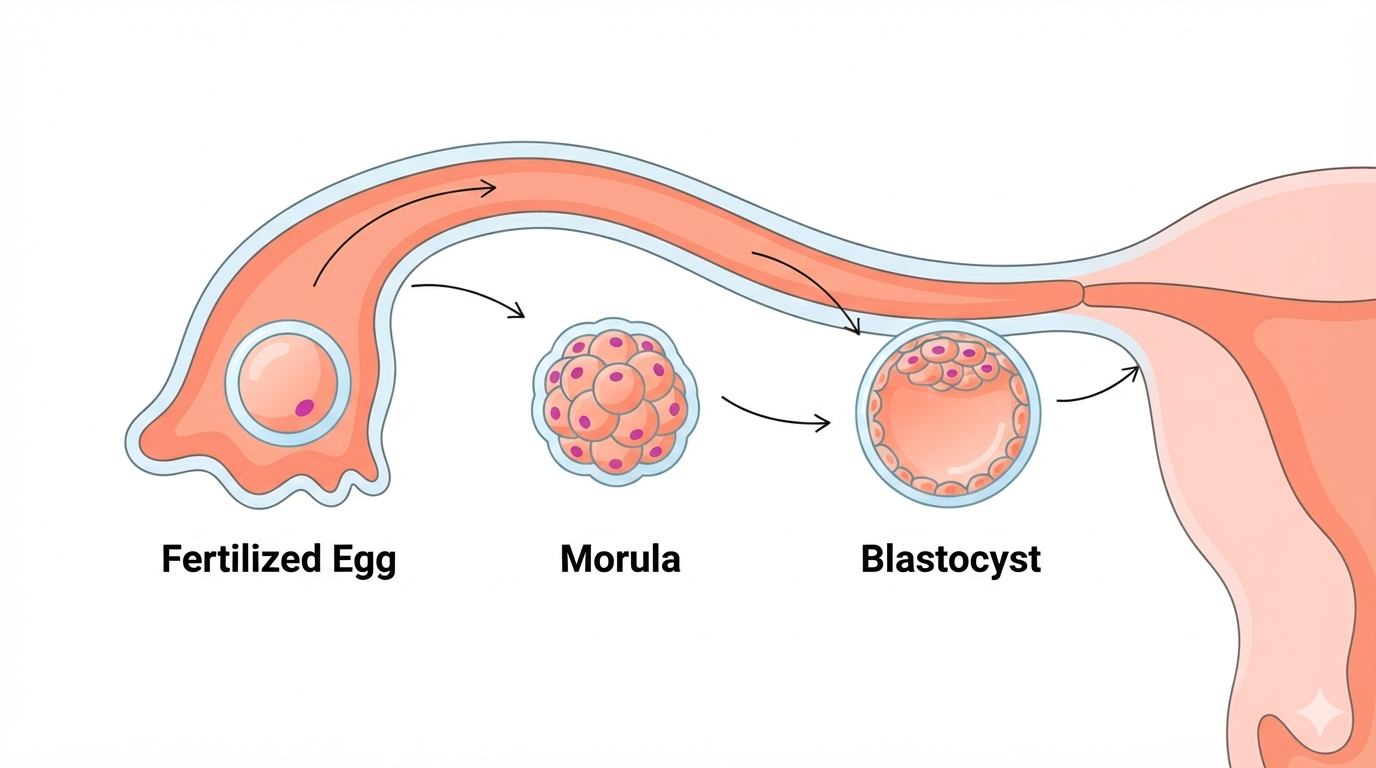
There's still no embryo to measure by size comparisons like "poppy seed" — those start around week 4. What exists at 3 weeks is a rapidly dividing cluster of cells: first a solid ball called a morula (16–32 cells, still smaller than a grain of sand), then a blastocyst — a hollow, fluid-filled sphere of around 100–200 cells that forms by roughly day 5 after fertilization. The blastocyst is about 0.1–0.2 millimeters across, invisible to the naked eye and far too small for an ultrasound to pick up this early.
What You Might Notice at 3 Weeks Pregnant
For most of this week, there's genuinely nothing to feel — hCG, the hormone responsible for most early pregnancy symptoms, doesn't start being produced until implantation begins, which is usually toward the very end of week 3 at the earliest. Here's what can show up if implantation happens on the early side:
Implantation spotting. As the blastocyst burrows into the uterine lining, some people notice a small amount of pink or brown spotting — often mistaken for a light period. It's common, but not universal; plenty of people implant with no visible sign at all.
Mild cramping. A dull, period-like cramp can accompany implantation as the lining adjusts around the burrowing blastocyst. It's usually brief and much lighter than typical period cramps.
Breast tenderness. If hCG and progesterone have started to rise, breasts can feel slightly fuller or more sensitive than usual — similar to premenstrual tenderness.
Fatigue. Rising progesterone has a sedating effect, and some people notice feeling unusually tired within days of implantation, well before a missed period.
Mild bloating. Hormonal shifts around implantation can slow digestion slightly, producing the same bloated feeling many people associate with PMS.
Feeling nothing at all this week is just as normal as noticing one of these — the timing and intensity of implantation symptoms vary a lot from person to person, and many people have zero signs until several weeks later.
What's Happening in Your Body
Week 3 is really a race against the clock for a single cluster of cells:
- Cell division continues. The fertilized egg keeps dividing roughly every 12–24 hours, first into a solid morula, then reorganizing into a fluid-filled blastocyst.
- The journey to the uterus. It takes about 3–4 days after fertilization for the blastocyst to travel the length of the fallopian tube.
- Hatching. Just before implantation, the blastocyst "hatches" — breaking free of the protective shell (zona pellucida) it's traveled in since fertilization.
- Implantation begins. Around 6–10 days after fertilization — typically the tail end of week 3 or the start of week 4 — the blastocyst burrows into the thickened uterine lining. (Source: ACOG)
- hCG production starts. Specialized cells on the outer layer of the blastocyst (the trophoblast) begin producing human chorionic gonadotropin (hCG) once implantation is underway — this is the hormone every pregnancy test is built to detect.
By the end of this week, if implantation started on schedule, your body has just begun making the hormone that will confirm the pregnancy — but there usually isn't enough of it yet for a home test to catch.
Tips If You're Trying to Conceive (or Suspect You're Pregnant)
This is the "two-week wait" stretch people talk about — here's how to spend it:
- Resist testing too early. hCG needs a few days after implantation to build up to detectable levels, so testing early in week 3 will almost always come back negative even if implantation is on track — that negative doesn't tell you much.
- Keep taking a prenatal vitamin with folic acid. Neural tube development begins within days of implantation, so this isn't a "wait until it's confirmed" habit.
- Cut back on alcohol and tobacco now, since you may already be pregnant without knowing it yet.
- Eat nutrient-dense meals. Focus on folate, iron, and protein — leafy greens, beans, lean meat, and citrus are easy places to start.
- Keep up moderate exercise, unless your provider has told you otherwise — there's no need to change your routine yet.
- Manage stress where you can. The wait for a testable result is genuinely stressful for a lot of people; distraction (not obsessive symptom-tracking) tends to help more than either strategy alone.
Tips for Partners
- Help create distraction, not pressure. The two-week wait is easier with something to look forward to — plan something low-key for the days ahead rather than counting down out loud.
- Match the healthy habits. Cutting back on alcohol together and eating well alongside your partner makes it easier for both of you to stick with it.
- Watch for early fatigue or mood shifts and offer to take something off their plate without needing it spelled out.
- Hold off on your own excitement-driven testing pressure. Wanting to know is normal, but pushing for an early test adds stress without changing the timeline.
When You'll Actually Know You're Pregnant
Implantation typically completes by early week 4, and hCG roughly doubles every 48–72 hours after that. Most home pregnancy tests need a threshold of around 20–25 mIU/mL of hCG to register a positive — a level most people don't reach until a few days before or around their missed period, which lands in week 4 to 5. A handful of ultra-sensitive tests can occasionally catch a faint positive a couple of days earlier if implantation happened on the early side, but a negative result this week doesn't rule anything out — it's simply still too soon to tell for most people.
FAQ
Is there a baby at 3 weeks pregnant? Not yet in the sense of an embryo. What exists is a blastocyst — a cluster of around 100–200 cells — that's either traveling to the uterus or just beginning to implant, depending on where you are in the week.
Can you get a positive pregnancy test at 3 weeks pregnant? It's possible but uncommon. hCG only starts being produced once implantation begins, which is typically the very end of this week at the earliest — most people won't have enough hormone built up for a home test until week 4 or later.
Is implantation bleeding the same as a period at 3 weeks? No, though it can look similar. Implantation spotting is usually lighter, shorter, and pinker or browner than a typical period. If you're unsure which one you're seeing, it's worth mentioning to your provider, especially if the bleeding is heavy.
What symptoms should I actually expect at 3 weeks pregnant? For most of the week, none — hormone levels haven't risen enough yet. If implantation happens early, some people notice light spotting, mild cramping, or breast tenderness toward the end of the week, but plenty of people feel nothing at all.
When does implantation happen? Typically 6–10 days after fertilization, which usually falls at the very end of week 3 or the start of week 4 using standard gestational dating. (Source: ACOG)
Should I keep taking prenatal vitamins if I don't know for sure I'm pregnant? Yes. Neural tube development begins right around the time of implantation, often before a positive test is possible, which is why providers recommend starting folic acid before you're trying to conceive, not after confirmation.
What can I do at 3 weeks to support a healthy pregnancy? Keep taking a prenatal vitamin with folic acid, cut back on alcohol and tobacco, eat a balanced diet, and hold off on testing until at least the end of the week to avoid a misleading false negative.
Pregnancy Checklist at Week 3
- Keep taking a prenatal vitamin with folic acid
- Cut back on alcohol and tobacco
- Hold off on testing until at least the end of the week
- Eat folate- and iron-rich meals
- Keep up moderate exercise unless told otherwise by your provider
- Plan a distraction or two for the wait — this stretch is easier with something to focus on
Related guides
- 2 Week Pregnant: Symptoms, Baby Size & What to Expect — what's happening the week before this one
- Pregnancy Week by Week: A Complete Guide — see what happens in every week and trimester, from implantation to full term
- How Is Your Due Date Actually Calculated? — the exact formula behind your due date, plus a free calculator
Implantation is the quiet turning point of this whole process — once it starts, your body is already several steps ahead of any test you can buy.
Ready to throw the best reveal?
Create your free Poppit event — invitations, live betting pool, and registry in one link.
Create your event ✨