5 Weeks Pregnant: Symptoms, Baby Size & What to Expect
At 5 weeks pregnant, your baby is sesame-seed sized and the primitive heart tube starts forming. Symptoms, baby development, and a full week 5 checklist.
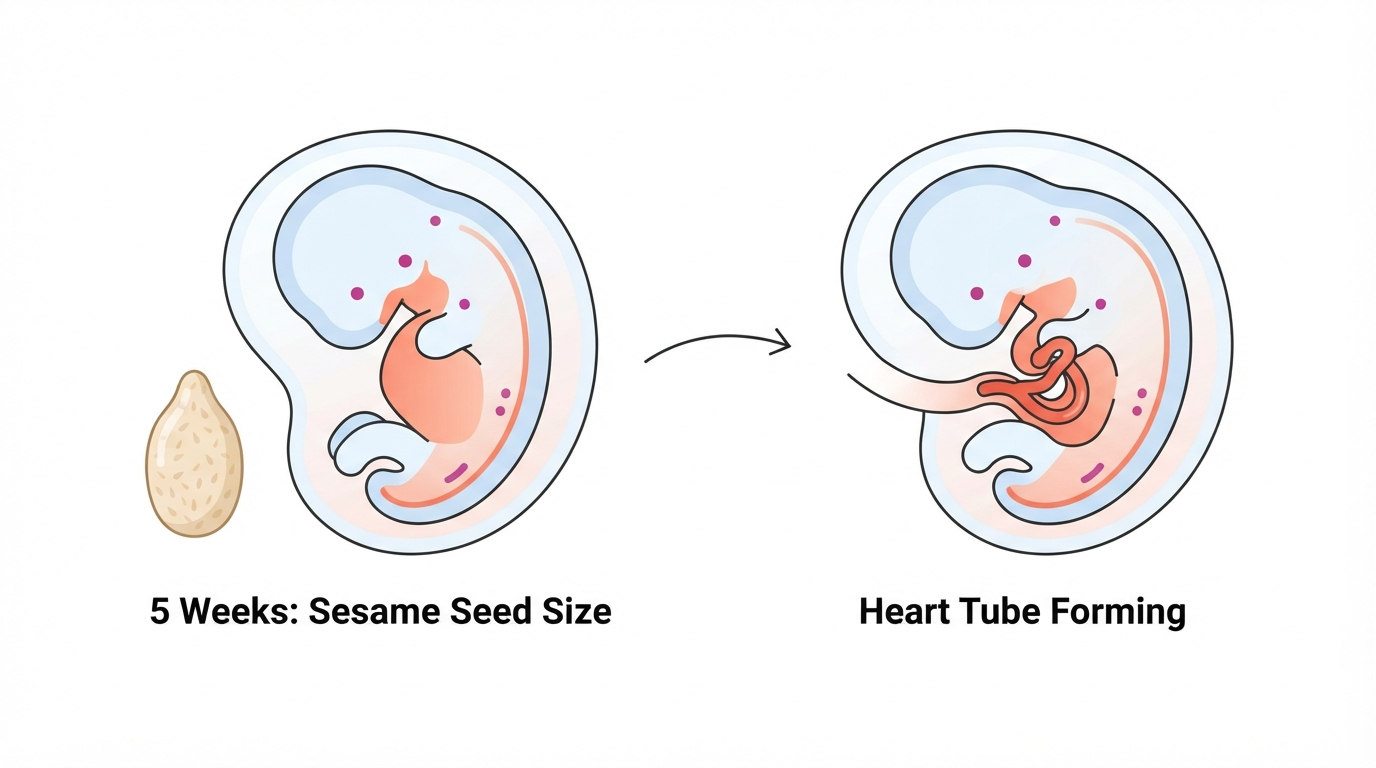
At 5 weeks pregnant, your baby is an embryo about the size of a sesame seed, and this is usually the week early pregnancy symptoms go from "maybe nothing" to impossible to ignore. hCG is climbing fast, the neural folds from last week are rising toward each other, and a brand-new structure — the primitive heart tube — starts taking shape.
If you're not sure your dates line up, gestational age counts from the first day of your last period (LMP), not from conception — so "5 weeks pregnant" usually means about 3 weeks since ovulation and roughly 2–3 weeks since implantation. For the full timeline, see our pregnancy week-by-week guide. If you're coming from last week's post, catch up on 4 weeks pregnant first.
Key takeaways
- Baby is about the size of a sesame seed (roughly 1.5–3 mm) and is still called an embryo.
- The primitive heart tube — the earliest form of the heart — starts forming this week, and the neural folds from last week continue rising toward each other along the embryo's back.
- Early pregnancy symptoms — nausea, breast tenderness, fatigue — typically intensify this week as hCG and progesterone keep climbing.
What "5 Weeks Pregnant" Actually Means
Using standard gestational dating, week 5 starts about 3 weeks after ovulation — right in the thick of early embryonic development. In fetal-age terms (counting from conception instead of your last period), this is closer to "3 weeks post-conception," which is why the same milestone can show up under different week numbers depending on which site or app you're reading.
For a lot of people, week 5 is when pregnancy starts to feel real rather than just confirmed — symptoms tend to ramp up noticeably compared to week 4.
Baby Size at 5 Weeks
At 5 weeks, your baby is an embryo about the size of a sesame seed — roughly 1.5 to 3 millimeters long. It's still not visible on a standard ultrasound as more than a small gestational sac and possibly a tiny yolk sac; a measurable embryo with a flicker of cardiac activity typically isn't detectable until around week 6. What's happening instead is rapid structural change: the three germ layers laid down last week (ectoderm, mesoderm, and endoderm) are actively folding and specializing into the earliest versions of the nervous system, heart, and gut.
The Heart Tube: What's Actually Forming This Week
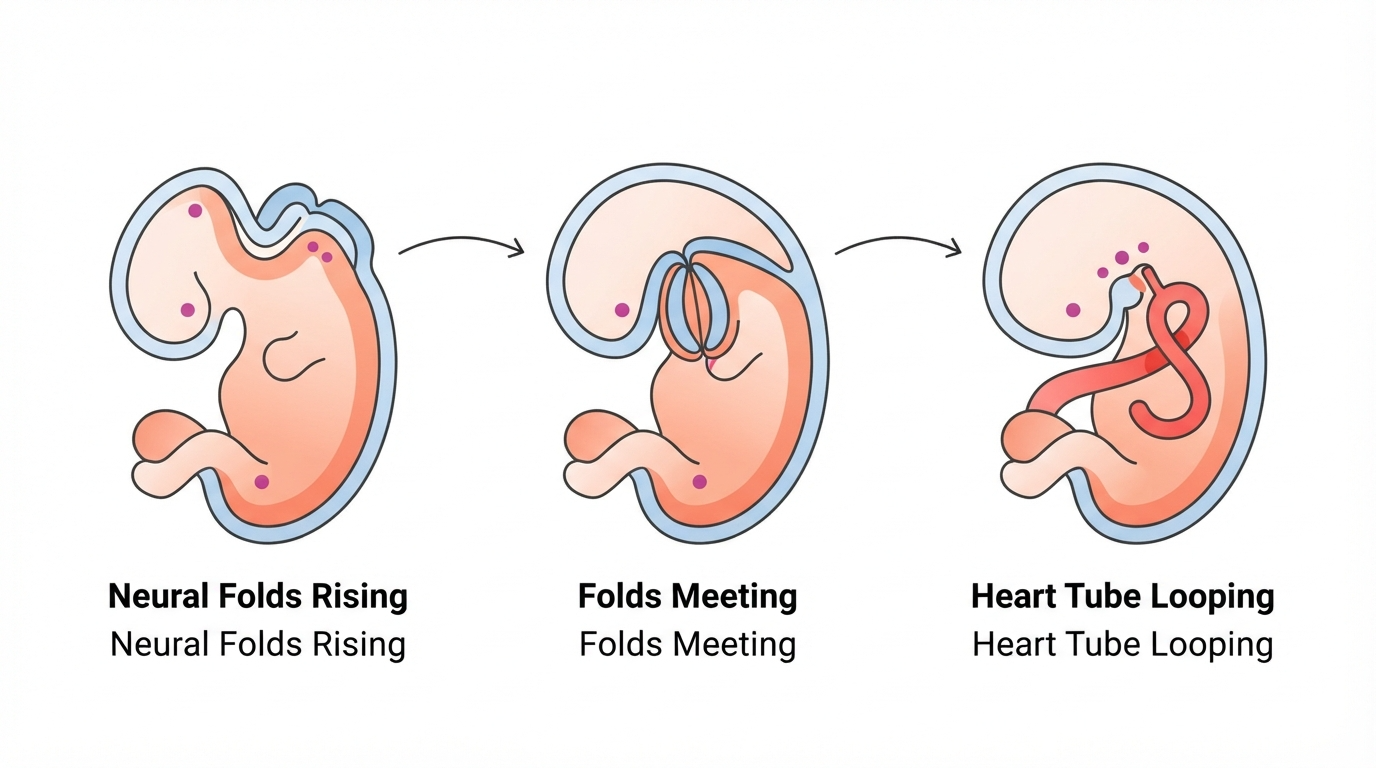
This is the headline event of week 5. Cells in the mesoderm layer begin organizing into a pair of parallel tubes that fuse into a single, straight primitive heart tube — the earliest form of your baby's heart. It doesn't look anything like a heart yet; it's a simple tube that will spend the next couple of weeks folding and looping into recognizable chambers. [NEEDS SOURCE: exact day-post-fertilization range for heart tube fusion]
At the same time, the neural folds — the raised edges of the neural tube that started forming last week — continue rising and moving toward the midline of the embryo's back, working toward closing into a completed tube. Two of the most important systems in the entire pregnancy, the heart and the nervous system, are being built side by side this week.
Why this matters for prenatal care. Because the heart and nervous system are both under active construction, this is one of the more sensitive windows for avoiding alcohol, certain medications, and other exposures your provider may have flagged. (General guidance — confirm specifics with your provider: ACOG)
What You Might Notice at 5 Weeks Pregnant
hCG and progesterone are both rising fast this week, and that combination is usually what pushes symptoms from "barely there" to genuinely noticeable. Not everyone feels the same things, but here's what commonly shows up:
Nausea, with or without vomiting. "Morning sickness" is a misnomer — it can hit at any time of day. It usually starts ramping up around week 5 or 6 and tends to peak between weeks 6 and 9.
Breast tenderness or swelling. Rising estrogen and progesterone keep increasing blood flow to breast tissue, and by week 5 a lot of people describe their breasts as noticeably fuller, heavier, or sore to the touch.
Fatigue that feels different from normal tiredness. Progesterone's sedating effect tends to deepen this week — many people describe it as a heaviness that a nap doesn't fully fix.
Frequent urination. Rising blood volume and hCG's effect on pelvic blood flow can send you to the bathroom more often, even though your uterus is still far too small to be pressing on your bladder yet.
Heightened sense of smell. A stronger-than-usual reaction to cooking smells, perfume, or coffee is common around this week and is thought to be linked to rising estrogen.
Mood swings. The same hormonal surge driving physical symptoms can make emotions feel closer to the surface than usual — this is expected, not a sign anything's wrong.
It's just as normal to feel little or nothing yet — symptom timing and intensity vary widely from person to person and even from pregnancy to pregnancy.
What's Happening in Your Body
- hCG keeps climbing. Levels continue roughly doubling every 2–3 days, which is what drives most of the intensifying symptoms this week.
- The heart tube forms. As covered above, this is the defining developmental event of week 5.
- The neural folds keep rising. The nervous system's earliest structure continues developing toward a fully closed tube.
- The placenta and umbilical cord keep developing. The trophoblast cells from the former blastocyst continue building out the structures that will eventually take over hormone production from your ovaries.
- Progesterone stays elevated, still maintained by the corpus luteum, keeping the uterine lining stable until the placenta is mature enough to take over.
Tips for Week 5
Keep taking your prenatal vitamin with folic acid. Neural development is still very much in progress this week, so consistency matters more than ever.
Have small snacks on hand. An empty stomach can make nausea worse for a lot of people; small, frequent, bland snacks (crackers, toast) are a common first line of defense.
Stay hydrated, especially if nausea is an issue. Sipping water or an electrolyte drink throughout the day is easier to tolerate than large amounts at once.
Confirm your first prenatal appointment. If you haven't called yet, week 5 is a good time — most providers schedule the first visit around 8 weeks, but getting on the calendar early helps.
Cut out alcohol and tobacco, and check medications with your provider. With the heart and nervous system both actively forming, this is a high-leverage week to be careful about exposures.
Give yourself permission to slow down. Between nausea and fatigue, week 5 is a common week to need more rest than usual — that's expected, not a failure to "push through."
Tips for Partners
- Take nausea seriously, even if it looks mild from the outside. Food aversions and queasiness can make normal routines (cooking, certain smells in the house) genuinely hard this week.
- Handle logistics where you can — scheduling the first prenatal appointment or picking up bland snacks are small, concrete ways to help.
- Expect mood swings and don't take them personally — they're hormonal, not a reflection of how your partner feels about you.
- Ask before making plans around food or scent-heavy activities, since sensitivities can shift day to day this week.
FAQ
How big is my baby at 5 weeks pregnant? About the size of a sesame seed — roughly 1.5 to 3 millimeters. It's still called an embryo at this stage.
What is developing in my baby at 5 weeks? The primitive heart tube — the earliest form of the heart — starts forming, and the neural folds continue rising toward closing into the neural tube.
Can you see a heartbeat at 5 weeks? Usually not yet. The heart tube is only just forming this week; a measurable flicker of cardiac activity on ultrasound typically isn't detectable until around week 6.
What symptoms are normal at 5 weeks pregnant? Nausea, breast tenderness, fatigue, frequent urination, a heightened sense of smell, and mood swings are all common. Feeling little or nothing yet is also completely normal.
Why do pregnancy symptoms suddenly get stronger around week 5? hCG and progesterone are both climbing quickly this week, and that combined hormonal surge is usually what drives the jump in symptom intensity compared to week 4.
Is it normal to not have any symptoms at 5 weeks? Yes. Symptom timing and severity vary enormously — plenty of confirmed, healthy pregnancies feel largely symptom-free at 5 weeks.
When should I schedule my first prenatal appointment? Most providers schedule the first visit around 8 weeks, but it's fine to call as soon as you have a positive test to get on the calendar.
Pregnancy Checklist at Week 5
- Confirm your pregnancy with a follow-up test or blood test if your home test result was faint
- Keep taking a prenatal vitamin with folic acid daily
- Call to schedule your first prenatal appointment if you haven't already
- Keep small, bland snacks on hand in case nausea shows up
- Cut out alcohol and tobacco, and check any medications with your provider
- Rest when fatigue or nausea hits — it's a normal response to rising hormones
Related guides
- 4 Weeks Pregnant: Symptoms, Baby Size & What to Expect — what happens the week before, when the neural tube first starts forming
- Pregnancy Week by Week: A Complete Guide — see what happens in every week and trimester, from implantation to full term
- How Is Your Due Date Actually Calculated? — the exact formula behind your due date, plus a free calculator
Week 5 is where quiet early development turns into a week you can actually feel — while the heart tube and neural folds are being built beneath the surface, your body is running hard on rising hormones to support them.
Read related post: 4 Weeks Pregnant: Symptoms, Baby Size & What to Expect
Ready to throw the best reveal?
Create your free Poppit event — invitations, live betting pool, and registry in one link.
Create your event ✨